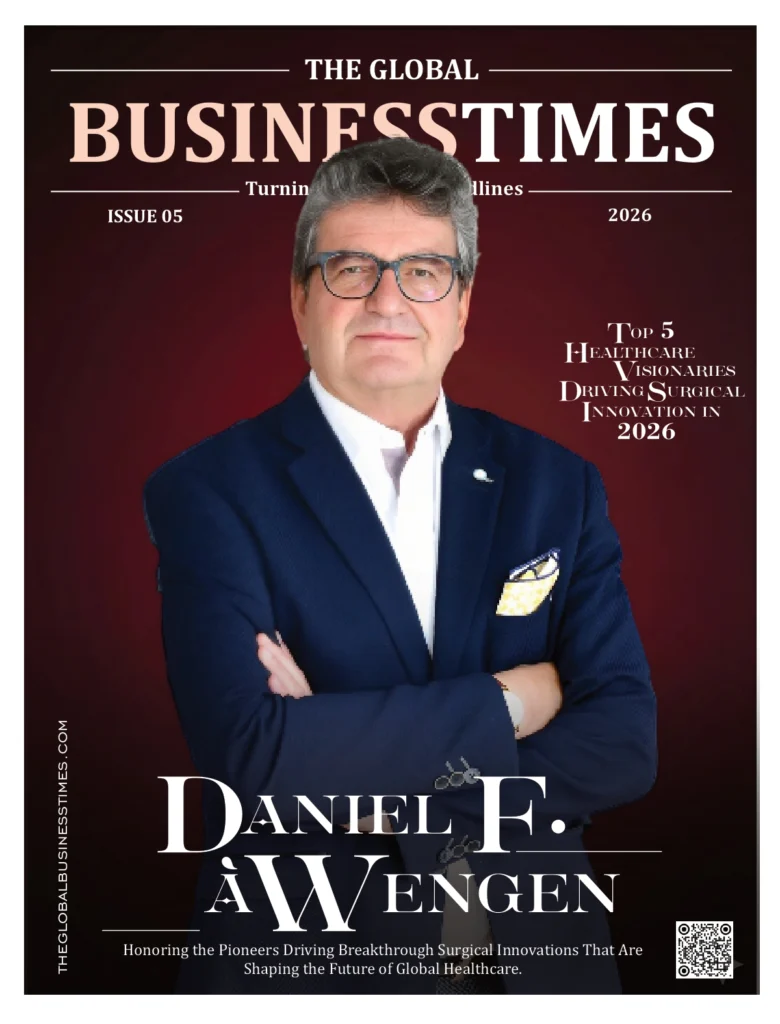
Daniel F. à Wengen Honoring the Pioneers Driving Breakthrough Surgical Innovations That Are Shaping the Future of Global Healthcare.
Prof. Dr. Daniel F. à Wengen: The Surgeon Who Gave the World a Freer Breath and a Clearer Sound “Air is life and breathing is freedom.” For Prof. Dr. Daniel F. à Wengen, those words are not simply poetic, they are the foundation of a lifelong mission. Over several decades, the Swiss facial plastic and otologic surgeon has transformed how medicine approaches two of the most fundamental functions of human life: breathing and hearing. Through pioneering implants, meticulous surgical techniques, and a relentless commitment to innovation, he has given thousands of patients something many people never think about until it is lost, the ability to breathe and hear with ease. Today, more than ten thousand people around the world live with his Titanium Breathe Implant, while many more benefit from middle ear prostheses and concepts that grew out of his early work on hearing implants. Yet behind this impressive record of patents, surgical techniques, and international recognition stands a physician who, above all, measures success in quiet, deeply personal moments. It is the patient who finally sleeps through the night without snoring, the individual who can walk up a flight of stairs without struggling for air, or the person who hears a loved one clearly again. Those are the outcomes that truly define his legacy. From Basel to California: A Career Forged in Curiosity and Courage Prof. à Wengen’s story begins in Switzerland, at the University of Basel and the University Hospital of Basel, where he completed his specialist training in otorhinolaryngology. Very early in his career, he realised that he was not content to simply apply existing techniques. He was drawn to the unknown frontiers of his specialty, where anatomy, physics, and technology intersect, and where completely new solutions could be engineered for long standing medical problems. After his initial specialist training, he undertook a surgical fellowship at the University of Davis Medical Center in Sacramento, California, from 1991 to 1992. There, he refined his manual skills and deepened his understanding of complex head and neck as well as skullbase procedures. This period strengthened his conviction that truly outstanding surgery demands both technical mastery and a profound respect for anatomy. The real turning point, however, came with a generous research grant from the Swiss National Science Foundation, which allowed him to spend 1992 to 1993 as an Otologic Fellow at Stanford University in Palo Alto. At Stanford, he joined a cutting edge research laboratory focused on implantable hearing aids, led by Professor Dick Goode. Rather than working on incremental improvements to existing hearing aids, this group was exploring the radical idea of directly driving the structures of the middle ear. Immersed in this environment, Prof. à Wengen started a new research program and helped to develop a new type of middle ear implant that bypassed the limitations of conventional acoustic hearing aids. By transmitting sound energy directly to the hearing structures of the middle ear, this implant provided far superior sound quality and clarity. This pioneering work eventually contributed to the development of the Vibrant Soundbridge, which is today regarded as the most successful middle ear implant in the world. It also became the core topic of his academic thesis, and a contribution he remains deeply proud of. Following his time in California, he returned to Switzerland to pursue further top level otologic training at the University Hospital Zurich under Professor Ugo Fisch, one of the most respected names in ear surgery. This cemented his expertise in otologic and skull base procedures and prepared him for the broader vision that would define his later career. Back at the University Hospital of Basel, his focus gradually expanded. What began as a deep engagement with otologic surgery naturally evolved into a growing fascination with rhinoplasty and aesthetic, yet functional, nasal surgery. Instead of choosing between ear or nose, functional or aesthetic work, he chose to master all of them. That choice required courage and years of dedication, but it became one of the defining strengths of his career. Refusing Limits and Accepting the Cost of Innovation Throughout this journey, Prof. à Wengen consistently refused to let himself be confined by established boundaries. Whether in otologic implants or functional and aesthetic nasal surgery, he pushed himself to question assumptions, challenge conventional wisdom, and design better solutions for patients. “I never allowed myself to be limited in any of my areas of interest,” he reflects. “It took a great deal of courage to push boundaries and develop new surgical techniques, implants, and instruments.” That courage always came with risk. Innovators in medicine must accept not only the possibility of technical failure, but also the social risk of misunderstanding, criticism, and sometimes ridicule. Many of his ideas and techniques were so far ahead of general practice that colleagues struggled to accept them. He experienced resistance, scepticism, and even active obstruction from some peers. One of the hardest lessons of his career has been that innovation often needs around twenty years before it is fully accepted in the field. Despite this, he persisted. He remained guided by logic, anatomy, patient benefit, and long term clinical outcomes rather than short term popularity. That decision, repeated over decades, laid the foundation for the contributions that now define his name. ORL Center Basel: A Home for High End Surgery of Nose, Face, and Ear As the founder and lead surgeon of the ORL Center in Basel, Prof. à Wengen has created a practice that reflects his philosophy in every detail. The center is dedicated to high end functional and aesthetic surgery of the nose, face, and ear, three areas that are anatomically distinct and technically demanding, yet deeply interconnected in everyday function. For him, true excellence in surgery begins with knowledge. A deep understanding of human anatomy forms the basis of every operation. From there, a three dimensional way of thinking allows the surgeon to visualise structures, plan precise interventions, and anticipate how each manoeuvre will affect the final functional and aesthetic outcome. Manual dexterity, while essential,