

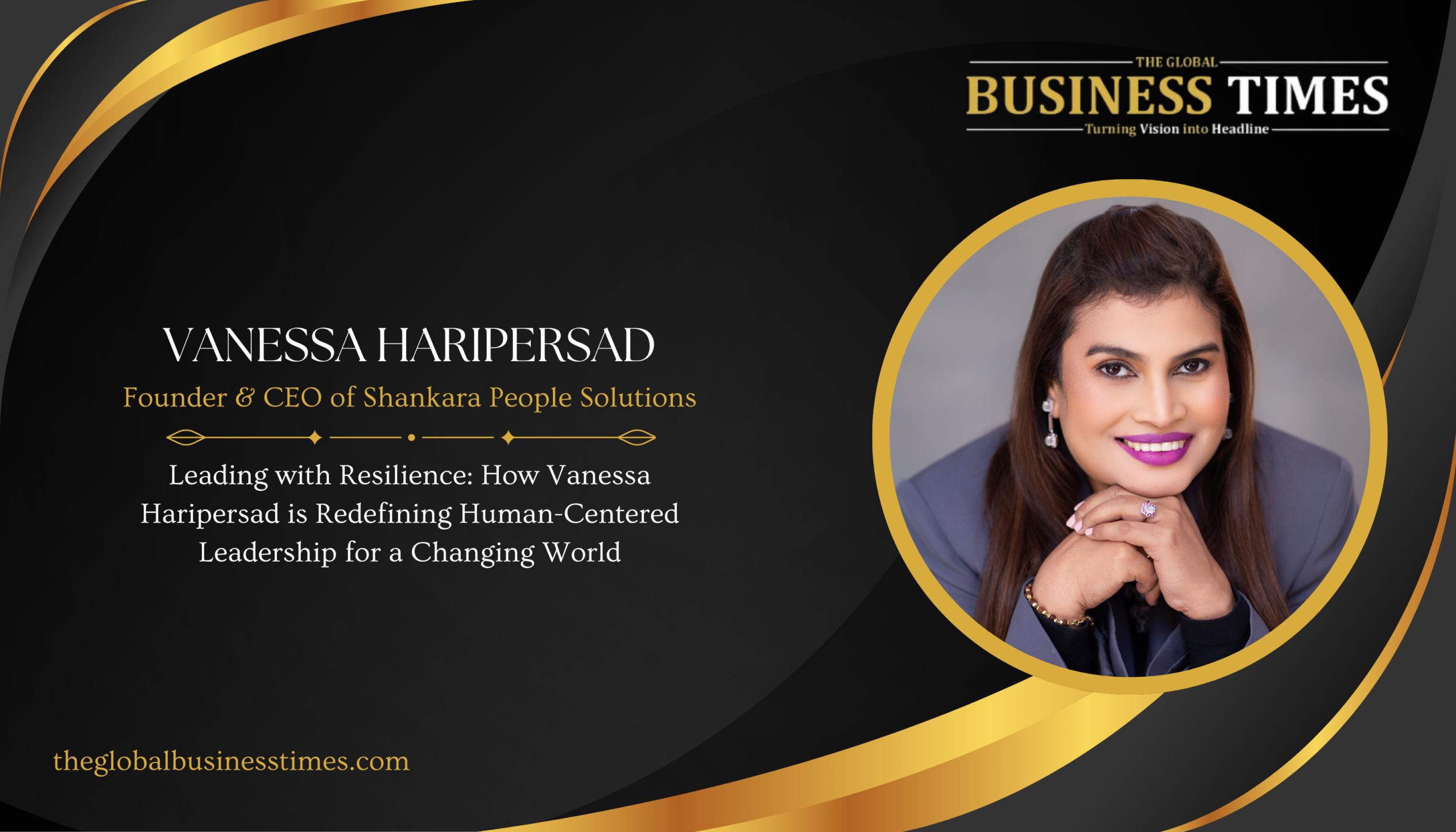
Leading with Resilience: How Vanessa Haripersad is Redefining Human-Centered Leadership for a Changing World
Transforming Leadership from the Inside Out
In an era where disruption has become the norm rather than the exception, leadership is no longer defined solely by strategy, technical expertise, or commercial success. Today’s leaders are expected to inspire confidence amid uncertainty, cultivate resilient teams, navigate constant change, and foster workplaces where people can perform at their best without compromising their wellbeing. As organizations across the globe grapple with burnout, workforce transformation, digital disruption, and evolving employee expectations, a new kind of leadership is emerging one grounded not in authority alone, but in self-awareness, emotional intelligence, and human connection.
Few leaders embody this evolution more profoundly than Vanessa Haripersad, Founder and CEO of Shankara People Solutions. With more than 24 years of experience in human capital, executive leadership, talent strategy, and transformational coaching, Vanessa has become one of South Africa’s most respected voices on resilient leadership and workplace transformation. An accomplished executive coach, international keynote speaker, leadership strategist, and creator of the globally recognized SCCR Resilient Leadership Framework, she has dedicated her career to helping leaders navigate complexity while remaining deeply connected to themselves and the people they serve.
Her work represents far more than leadership development. It is a movement toward creating organizations where performance and wellbeing coexist, where resilience is cultivated before crisis strikes, and where authentic leadership becomes the foundation for sustainable success. Behind every framework she teaches and every stage she stands upon lies decades of experience, thousands of conversations, and a deeply personal understanding of what it truly means to lead through adversity.
A Career Built on Understanding People
Long before becoming an internationally recognized leadership coach, Vanessa built an extraordinary career in human resources and recruitment. Over the course of more than two decades, she interviewed upwards of 20,000 professionals, ranging from graduates beginning their careers to senior executives responsible for leading major organizations.
While every interview revealed a different story, Vanessa began noticing a striking pattern. The people who consistently succeeded were not necessarily those with the strongest technical qualifications or the most impressive résumés. Intelligence and expertise certainly mattered, but they were rarely the defining factors that separated exceptional leaders from those who struggled under pressure.
Instead, the qualities that consistently predicted long-term success were far more human: self-awareness, adaptability, emotional resilience, and the ability to remain calm when circumstances became uncertain. Again and again, Vanessa encountered highly capable professionals who possessed remarkable technical knowledge yet quietly battled anxiety, self-doubt, burnout, and overwhelming pressure. Many appeared successful on the outside while internally questioning their abilities and struggling to sustain their performance.
These experiences fundamentally changed the way she viewed leadership. Traditional HR practices were highly effective at assessing competencies, filling positions, and measuring performance. Yet they often lacked the tools to address the emotional and psychological dimensions that shaped how individuals actually experienced leadership. Vanessa realized that organizations were investing heavily in developing skills while overlooking the inner capabilities that determined whether those skills could be applied effectively during times of uncertainty.
That realization became the catalyst for an entirely new chapter in her professional journey. Rather than focusing solely on organizational systems, she chose to work directly with the human beings behind the job titles, helping leaders strengthen the mindset, emotional resilience, and self-awareness required to thrive in an increasingly complex world.
Building Shankara People Solutions
This vision ultimately led to the creation of Shankara People Solutions, an organization dedicated to transforming leadership by placing people at the centre of organizational success. Founded on the belief that exceptional businesses are built by emotionally healthy, resilient, and self-aware leaders, Shankara People Solutions goes far beyond traditional executive coaching or leadership consulting. It serves as a strategic partner for organizations seeking sustainable cultural transformation through evidence-based leadership development, coaching, mentorship, and resilience-building initiatives.
Under Vanessa’s leadership, the organization has become recognized for helping executives and teams navigate change with confidence while strengthening collaboration, trust, emotional intelligence, and workplace wellbeing. Her philosophy challenges one of the longest-standing assumptions in business—that high performance requires personal sacrifice.
For decades, many organizations celebrated relentless work, constant availability, and the ability to push through exhaustion as signs of strong leadership. While these behaviours often produced short-term results, they also contributed to rising levels of burnout, disengagement, anxiety, and declining employee wellbeing. Vanessa believes organizations no longer need to choose between performance and people. Instead, she demonstrates that the healthiest workplaces consistently produce the strongest long-term results because people perform best when they feel psychologically safe, respected, and supported.
This belief has become the cornerstone of Shankara People Solutions’ work across leadership development, executive coaching, and organizational transformation.
Leadership in an Age of Uncertainty
Modern leaders operate in an environment unlike anything previous generations experienced. Global markets shift overnight. Artificial intelligence is reshaping industries at unprecedented speed. Economic uncertainty, geopolitical instability, hybrid work models, and rapidly changing workforce expectations require leaders to make complex decisions with incomplete information.
Many organizations describe this reality using the acronym VUCA—Volatility, Uncertainty, Complexity, and Ambiguity. While countless leadership models attempt to help executives navigate this landscape, Vanessa believes one fundamental misconception continues to undermine effective leadership. For years, leaders were taught that their role was to always have the answers. Today’s world no longer rewards certainty. Instead, it demands steadiness.
According to Vanessa, people rarely expect leaders to predict every challenge. What they seek is confidence, clarity, emotional stability, and the reassurance that someone can guide them through uncertainty without transmitting fear throughout the organization. A leader’s emotional state influences every interaction within a team. When leaders become overwhelmed by stress, that tension often spreads throughout the workplace. Anxiety becomes contagious. Decision-making deteriorates. Innovation slows. Trust begins to erode.
Conversely, leaders who remain grounded during difficult circumstances create environments where teams feel secure enough to collaborate, solve problems creatively, and adapt with confidence. This understanding has become central to Vanessa’s philosophy. Leadership is not simply about communication; it is about presence. People observe how leaders respond under pressure long before they evaluate the words they speak. The calmness, empathy, and authenticity demonstrated during moments of uncertainty often become the qualities that define great leadership far more than technical expertise or strategic planning.
For Vanessa, developing leaders who embody these qualities is no longer optional—it is one of the most important investments organizations can make in preparing for the future.
The SCCR Framework: A Practical Blueprint for Resilient Leadership
At the heart of Vanessa Haripersad’s work lies a leadership framework that has gained international recognition for its relevance in today’s increasingly complex business environment. Known as the SCCR Resilient Leadership Framework, the model is far more than a theoretical concept. It is a practical operating system developed through years of executive coaching, organizational consulting, and personal experience navigating adversity. While many leadership models focus on external competencies, SCCR begins with the inner work of leadership, recognizing that sustainable influence starts long before strategic decisions are made.
SCCR represents Self-Awareness, Compassion, Curiosity, and Resourcefulness, four interconnected principles that enable leaders to remain effective even during periods of uncertainty and disruption. Vanessa often explains that these principles were not created in a boardroom or academic setting. They emerged through lived experience, long before they became a structured methodology. Every conversation with leaders, every coaching engagement, and every personal challenge reinforced the need for a leadership approach that addresses both professional performance and personal resilience.
Self-awareness forms the foundation of the framework because leaders cannot manage what they fail to recognize within themselves. Understanding personal values, emotional triggers, behavioural patterns, and decision-making tendencies enables leaders to respond intentionally rather than react impulsively. Vanessa believes that leadership begins with the courage to examine oneself honestly. Leaders who develop this awareness are better equipped to inspire confidence, build trust, and make balanced decisions during challenging situations.
The second pillar, compassion, reflects the understanding that leadership is fundamentally about people. Compassion is often misunderstood as weakness or excessive empathy, yet Vanessa demonstrates that it is one of the strongest leadership capabilities an executive can possess. Compassion allows leaders to support themselves and others without sacrificing accountability. It encourages difficult conversations to be held with respect, setbacks to become opportunities for learning, and workplace cultures to foster psychological safety rather than fear. In environments where compassion is present, employees are more willing to contribute ideas, embrace innovation, and navigate change together.
Curiosity forms the third pillar of the SCCR Framework and serves as the driving force behind adaptability. Rather than becoming defensive when confronted with uncertainty, curious leaders remain open to learning, questioning assumptions, and exploring alternative solutions. Vanessa emphasizes that organizations cannot solve today’s challenges using yesterday’s thinking. Leaders who cultivate curiosity are better positioned to recognize emerging opportunities, adapt to changing market conditions, and encourage continuous learning throughout their teams. Curiosity transforms disruption from a threat into an opportunity for innovation.
The final pillar, resourcefulness, turns awareness and insight into meaningful action. Resourcefulness enables leaders to identify solutions despite limited resources, changing priorities, or unexpected setbacks. It reflects the ability to remain focused on possibilities rather than obstacles, empowering teams to overcome challenges through creativity, collaboration, and resilience. Vanessa believes resourcefulness is what transforms intention into measurable results, ensuring that leadership extends beyond ideas into practical, sustainable action.
Together, these four principles create a framework that equips leaders to navigate economic uncertainty, technological disruption, organizational transformation, and personal adversity without losing sight of their purpose or the people they lead. Rather than offering temporary motivation, the SCCR Framework provides leaders with practical tools they can apply in everyday decision-making, making resilience an ongoing practice rather than an occasional response to crisis.
Why Self-Awareness is the New Leadership Advantage
One of Vanessa’s most compelling messages is that leadership is transmitted long before it is communicated. Employees observe how leaders respond to setbacks, manage conflict, and handle uncertainty before they evaluate speeches, presentations, or strategic plans. Every interaction communicates far more than words alone.
This understanding has led Vanessa to place extraordinary emphasis on self-awareness as the defining characteristic of modern leadership. While organizations continue investing in technical capabilities and management skills, she believes the most influential leaders are those who understand themselves first. Self-awareness creates the emotional stability necessary to lead with confidence, authenticity, and consistency, particularly during times of pressure.
Leaders who lack self-awareness often unintentionally create environments characterized by confusion, fear, or inconsistency. Emotional reactions become contagious, influencing team morale, communication, and productivity. By contrast, self-aware leaders are able to regulate their responses, remain composed under pressure, and foster trust through their behaviour. Their presence provides reassurance during uncertain times, enabling teams to remain focused even when external circumstances become challenging.
For Vanessa, self-awareness is not a destination but a continuous practice of reflection, learning, and personal growth. It requires leaders to remain curious about their own behaviour, open to feedback, and willing to acknowledge both strengths and areas for development. This level of authenticity strengthens relationships, enhances decision-making, and creates cultures where openness and continuous improvement become the norm rather than the exception.
The Science Behind Emotional Resilience
Modern workplaces continue to experience unprecedented levels of stress. Economic uncertainty, digital transformation, increased workloads, and rapidly evolving expectations have fundamentally changed how professionals experience work. Against this backdrop, Vanessa advocates for a deeper understanding of emotional resilience and nervous system regulation as essential leadership competencies rather than optional wellbeing initiatives.
She explains that leaders influence their organizations not only through strategic decisions but also through their physiological state. A leader operating from chronic stress or anxiety unintentionally communicates that tension throughout the workplace. Teams instinctively respond to emotional cues, making it difficult to foster collaboration, creativity, and innovation when leadership itself is overwhelmed.
Conversely, emotionally regulated leaders create stability during uncertainty. They communicate calmly, make thoughtful decisions, and encourage constructive dialogue even in high-pressure environments. This steadiness enables employees to feel psychologically safe, strengthening trust, engagement, and resilience across the organization.
Vanessa frequently reminds leaders that strategy alone cannot compensate for emotional dysregulation. Even the most sophisticated business plans struggle to succeed when workplace cultures are driven by fear, exhaustion, or chronic stress. Sustainable organizational performance depends upon leaders who understand the connection between emotional wellbeing and business success.
This perspective represents a significant shift in leadership thinking. Emotional resilience is no longer viewed as a personal attribute but as a strategic capability that directly influences organizational culture, employee wellbeing, and long-term performance.
Redefining Burnout in the Modern Workplace
Among the most pressing challenges Vanessa encounters through her executive coaching practice is the growing prevalence of burnout, workplace anxiety, and imposter syndrome. While these issues are often addressed through isolated wellbeing initiatives, she believes they reflect much deeper organizational challenges.
According to Vanessa, many organizations continue attempting to solve fundamentally human problems using traditional performance management approaches. Burnout is frequently treated as an individual weakness rather than evidence that workplace systems themselves require transformation. Employees are encouraged to become more resilient without addressing the conditions that continuously deplete their physical and emotional resources.
Similarly, imposter syndrome affects countless accomplished professionals, including highly successful executives whose achievements suggest confidence but whose internal dialogue tells a different story. Vanessa has worked with leaders admired throughout their industries who privately question whether they truly deserve their success. Rather than viewing this as a confidence deficit, she sees it as the result of prolonged self-doubt reinforced by unrealistic expectations and relentless pressure.
Her approach encourages organizations to move beyond superficial wellbeing initiatives and instead integrate mental health, emotional intelligence, and resilience into leadership development itself. Wellbeing should not exist as a standalone HR programme or annual awareness campaign. It should become a measurable leadership capability that is actively developed, supported, and modelled by senior executives.
When organizations begin treating psychological wellbeing as an essential component of leadership effectiveness, they create healthier workplaces where both people and performance can flourish together. For Vanessa, this represents the future of organizational success, one where leadership is measured not only by financial outcomes but also by the wellbeing, engagement, and growth of the people who make those outcomes possible.
Leading with Purpose: Transforming Lives Beyond the Boardroom
Vanessa Haripersad’s leadership philosophy is not built solely on professional experience. It has been profoundly shaped by personal adversity, challenges that tested her resilience long before she began teaching it to others. Living with chronic illness transformed her understanding of leadership in ways no corporate role or executive position ever could. It challenged long-held beliefs about strength, productivity, and success, replacing them with a deeper appreciation for self-awareness, compassion, and intentional living.
Rather than viewing resilience as the ability to simply push through adversity, Vanessa came to understand it as the wisdom to recognize personal limits, seek support when necessary, and make decisions that protect long-term wellbeing. She discovered that sustainable leadership requires balance rather than constant sacrifice, and that true strength often lies in knowing when to pause instead of continually pressing forward.
Those personal experiences became the foundation upon which the SCCR Framework was built. Before it became an internationally recognized leadership model, it was a practical approach Vanessa relied upon in her own life. She learned to cultivate self-awareness by understanding her physical and emotional needs, practiced self-compassion during difficult periods, remained curious about new ways to adapt, and became increasingly resourceful in creating meaningful impact despite personal challenges.
This lived experience gives her work a level of authenticity that resonates deeply with leaders from every industry. Rather than speaking from theory alone, Vanessa shares lessons grounded in real-life experience, allowing executives to connect with her message on both a professional and personal level. Her journey reminds leaders that resilience is not about becoming invulnerable. It is about developing the inner strength to move forward with clarity, courage, and purpose regardless of the obstacles encountered.
Creating High-Performance Cultures Without Sacrificing Wellbeing
For decades, organizations have operated under the assumption that exceptional performance requires relentless effort, constant availability, and personal sacrifice. Vanessa challenges this outdated mindset by demonstrating that sustainable success is achieved when wellbeing becomes an integral part of organizational culture rather than an afterthought.
Through her coaching and consulting work, she helps organizations understand that high performance and mental wellbeing are not competing priorities. Instead, they strengthen one another when supported by the right leadership practices. Employees perform at their highest level when they feel psychologically safe, valued, respected, and connected to a meaningful purpose.
Vanessa believes that creating such cultures begins with leadership. Policies promoting work-life balance have little impact if senior leaders fail to model healthy behaviours themselves. When executives openly establish boundaries, prioritize recovery, and demonstrate emotional intelligence, they give permission for others throughout the organization to do the same. This creates a culture where wellbeing is practiced rather than simply discussed.
Communication also plays a critical role in building resilient organizations. Vanessa encourages leaders to develop emotional literacy across their teams, enabling honest conversations about challenges, expectations, and wellbeing. Human connection should not be reserved for annual retreats or leadership workshops. It must become part of everyday interactions, influencing how teams collaborate, solve problems, and support one another.
Purpose serves as another defining element of healthy organizational culture. Employees who understand how their work contributes to a broader mission are more engaged, adaptable, and resilient during periods of change. By helping organizations align individual purpose with organizational objectives, Vanessa enables teams to sustain high performance without compromising their health or wellbeing.
Her people-centered philosophy is helping businesses redefine success by demonstrating that organizations flourish when their people flourish.
Empowering the Next Generation Through Mentorship
Beyond executive leadership, Vanessa remains deeply committed to developing future generations of leaders. Throughout her career, mentorship has become one of the most meaningful aspects of her work, reflecting her belief that leadership development should begin long before individuals occupy senior positions.
Through the Graduate Mentorship Programme and other leadership initiatives, she has worked with countless young professionals navigating the transition from education into the workplace. These experiences have reinforced one consistent observation. Most graduates do not struggle because they lack intelligence or technical ability. Instead, they often underestimate their own value and lack the confidence to communicate their strengths effectively.
Vanessa believes mentorship provides something that traditional education often cannot. It offers guidance, encouragement, and perspective during moments of uncertainty. A skilled mentor helps individuals recognize potential they may not yet see within themselves, creating the confidence necessary to embrace new opportunities and overcome inevitable challenges.
Rather than providing all the answers, Vanessa encourages mentors to ask meaningful questions, helping emerging professionals develop critical thinking, resilience, and self-belief. This approach enables young leaders to become increasingly resourceful and independent while building the confidence required to thrive in rapidly evolving workplaces.
For Vanessa, mentorship represents an investment not only in individual careers but also in the future quality of leadership itself. Every young professional empowered today contributes to stronger organizations, healthier workplaces, and more compassionate leadership tomorrow.
Shankara Leadership Academy for Girls: Building Confidence Before Self-Doubt
Among Vanessa’s most inspiring initiatives is the upcoming Shankara Leadership Academy for Girls, a platform created to empower young women during one of the most influential stages of their personal development.
The inspiration behind the academy is deeply personal. As both a leader and a mother, Vanessa has witnessed the increasing pressures young girls face in today’s world. Social media, unrealistic expectations, comparison, and self-doubt often begin shaping confidence long before young women enter the workforce. By adulthood, many are already questioning their abilities despite possessing remarkable talent and potential.
Rather than waiting until women become senior executives to address these challenges, Vanessa believes leadership development should begin much earlier. The academy aims to equip girls with the emotional resilience, confidence, self-awareness, and leadership skills needed to navigate adolescence and adulthood with authenticity and purpose.
Its long-term vision extends far beyond leadership training. Vanessa hopes to nurture a generation of young women who enter universities, workplaces, and leadership positions already recognizing their own worth instead of spending years overcoming limiting beliefs or imposter syndrome.
By planting the seeds of resilience early in life, the academy seeks to transform not only individual futures but also the future of leadership across South Africa and beyond.
Preparing Leaders for an AI-Driven Future
The rapid rise of artificial intelligence and digital transformation continues reshaping industries across the globe. While automation is changing how organizations operate, Vanessa believes the future of leadership will become increasingly human.
As technology assumes responsibility for technical, administrative, and analytical tasks, qualities such as emotional intelligence, empathy, sound judgement, trust-building, and ethical decision-making will become even more valuable. These uniquely human capabilities cannot be replicated by algorithms and will increasingly define exceptional leadership.
Vanessa believes leadership development over the next decade must evolve accordingly. Organizations will need to invest less in teaching leaders to simply manage processes and more in helping them develop the emotional resilience, adaptability, and human-centered capabilities required to guide teams through constant disruption.
Frameworks such as SCCR provide practical guidance for this new reality by helping leaders remain grounded even when circumstances change rapidly. Rather than offering leadership principles suited only to stable environments, the framework prepares executives to navigate uncertainty with confidence, compassion, and resilience.
The future, Vanessa believes, will belong to leaders who combine technological understanding with deeply human leadership.
A Legacy of Resilient Leadership
Looking ahead, Vanessa Haripersad envisions resilient leadership becoming recognized not as a desirable soft skill but as essential organizational infrastructure. Just as financial planning, operational excellence, and innovation drive business success, resilience must become equally central to how organizations prepare leaders for the future.
Her vision extends across South Africa and onto the global stage. She hopes to see organizations embracing leadership cultures where empathy strengthens performance, emotional intelligence informs decision-making, and wellbeing becomes a strategic priority rather than a reactive initiative.
Through Shankara People Solutions, the SCCR Resilient Leadership Framework, executive coaching, international keynote speaking, mentorship programmes, and the Shankara Leadership Academy for Girls, Vanessa continues building a legacy rooted in one enduring belief: organizations succeed because people succeed.
Her impact is measured not only by leadership awards, advisory board appointments, or international recognition but by the transformation experienced by the individuals and organizations she serves. Every executive who leads with greater compassion, every team that discovers renewed resilience, every young professional who gains confidence, and every future leader empowered through mentorship reflects the deeper purpose behind her work.
In a world defined by constant change, Vanessa Haripersad is helping redefine what exceptional leadership truly means. Her journey demonstrates that the strongest leaders are not those who possess all the answers, but those who remain grounded in self-awareness, lead with compassion, embrace curiosity, and inspire others through resourcefulness and authenticity. As businesses continue navigating an increasingly uncertain future, her vision offers a powerful reminder that sustainable success begins not with systems or strategies, but with people. It is this unwavering commitment to human potential that continues to position Vanessa Haripersad among the most influential voices shaping the future of leadership and organizational transformation.