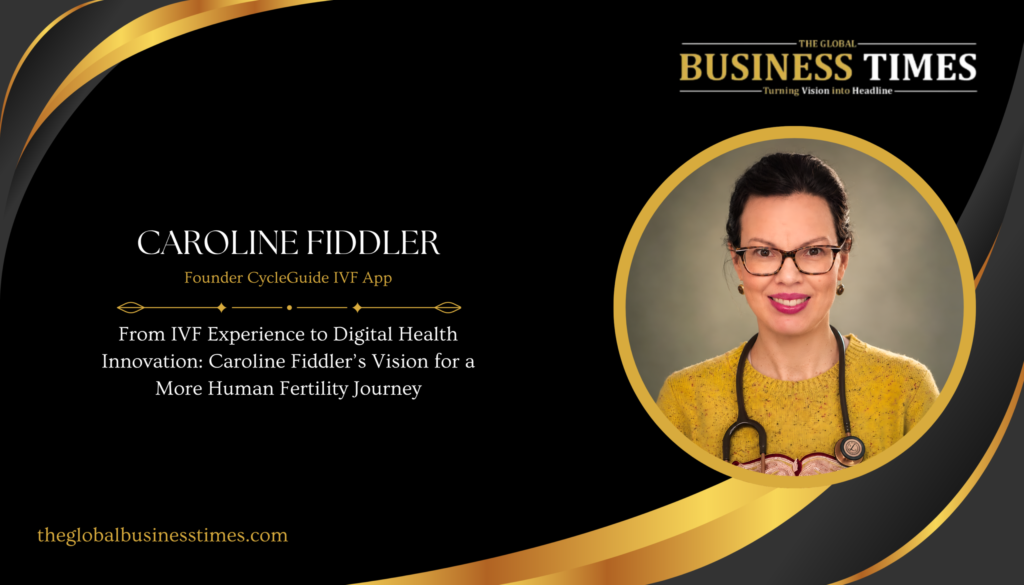
From IVF Experience to Digital Health Innovation: Caroline Fiddler’s Vision for a More Human Fertility Journey
From IVF Experience to Digital Health Innovation: Caroline Fiddler’s Vision for a More Human Fertility Journey For many patients, an IVF journey is defined by hope, anticipation and the possibility of a long-awaited family. Yet behind those emotions is a highly structured and demanding medical process involving medications, blood tests, ultrasounds, appointments, procedures and instructions that can change with little notice. For Caroline Fiddler, the experience revealed something that her years in medicine had not fully prepared her to understand: the patient is often responsible for carrying an extraordinary amount of the treatment process outside the clinic. A medical doctor with experience across multiple healthcare environments, Fiddler understood clinical systems from the inside. But becoming an IVF patient gave her an entirely different perspective. It was this intersection of professional knowledge and personal experience that led her to create CycleGuide, a purpose-built digital tool designed to make fertility treatment more organised, understandable and manageable. Today, Fiddler represents a growing generation of healthcare innovators who are not simply asking how technology can make medicine faster, but how it can make healthcare more human. When the Doctor Became the Patient Fiddler’s path into medicine began with a natural fascination with science and a desire to engage directly with people. Medical school offered both intellectual challenge and meaningful patient interaction, and she found much of clinical medicine deeply rewarding. However, she also encountered the limitations of traditional healthcare environments. Hospital systems could be rigid, hierarchical and difficult to change. Even straightforward suggestions designed to improve workflow could struggle to gain traction. Her perspective changed profoundly when she experienced IVF herself. During her first IVF cycles, Fiddler found herself navigating the same complexity faced by countless patients. Treatment instructions were frequently delivered through paper documents and telephone calls. Medication schedules changed according to test results. Appointments and procedures had to be coordinated around work and everyday responsibilities. Important instructions could arrive during a busy moment when writing them down was difficult or impossible. The experience was particularly striking because she was a doctor. “If I am overwhelmed deciding if my menstrual flow is sufficiently heavy to designate it Day 1 and hence the start of my cycle,” she reflected, “then how must others feel without a healthcare background?” The question became the foundation of CycleGuide. Fiddler realised that fertility treatment was placing a substantial logistical and mental burden on patients, while the systems supporting them had not evolved at the same pace as the medicine itself. Identifying a Problem Hiding in Plain Sight IVF treatment often lasts two to three weeks, but its complexity can make those weeks feel considerably longer. Medication instructions may change. Blood tests and ultrasounds determine the next steps. Procedures must be carefully timed. Patients may need to administer injections correctly while simultaneously managing work, family and the emotional uncertainty of treatment. For Fiddler, traditional paper-based treatment instructions were simply not flexible enough. A printed table could provide an initial schedule, but it could not easily adapt when treatment changed. Days of the week might not be clearly represented. Additional instructions could not simply be inserted. And when a fertility nurse called with an update, the patient was often expected to record the new information themselves. The problem was not necessarily a lack of clinical expertise. It was a communication and coordination gap. Fiddler began imagining a simple digital solution that could supplement existing clinical processes without adding unnecessary complexity. Rather than creating another elaborate health platform, she wanted something that would focus on the practical reality of IVF: what does the patient need to do today, tomorrow and throughout the cycle? That philosophy became central to CycleGuide. Designing Around the Patient CycleGuide was conceived as a simple reminder and treatment-management application specifically designed for fertility treatment. Its central interface provides a monthly calendar, allowing patients to see an entire treatment cycle at a glance. Below the calendar, users can view the tasks required for the current day and mark them as completed. The system uses colour-coded categories for key components of treatment, including Day 1, medication, blood tests, ultrasounds, procedures and appointments. Individual tasks can be modified, including medication end dates, reflecting the reality that IVF instructions often change as treatment progresses. Notifications can help remind patients when tasks need to be completed, while a pre-cycle checklist helps users prepare before treatment begins. The purpose is not to replace the fertility team. It is to help patients better understand and manage the instructions they have already been given. Fiddler deliberately resisted the temptation to make CycleGuide increasingly complicated. During the early development process, she received advice from Jarrod MacFarlane, project manager at Appetiser Apps, that stayed with her: an app should not become complicated simply because more features are possible. Users generally want the basics to work exceptionally well. That principle became an important leadership lesson. For Fiddler, simplicity is not a lack of ambition. It is part of good healthcare design. Two Perspectives, One Purpose What distinguishes Fiddler’s approach is the way two professional identities coexist within her work. As a doctor, she understands clinical workflows, healthcare systems and the consequences of inefficient processes. As a patient, she understands what those inefficiencies feel like from the other side. Her medical career has exposed her to hospitals, pathology laboratories, radiology departments, rehabilitation programs, emergency medicine and radiation oncology, among other environments. Each setting showed her different systems, requirements and shortcomings. Her experience in radiation oncology was particularly influential. While working in Perth, Western Australia, she proposed that administrative staff proactively chase pathology and radiology results before new patient appointments. This would allow doctors to focus on understanding the patient and preparing an appropriate treatment plan instead of spending valuable clinical time locating external reports. The idea was implemented quickly and worked effectively. For Fiddler, it demonstrated that small improvements in workflow can have a significant impact on both staff and patients. Years later, her IVF experience brought that lesson into sharper focus. She began asking how patients were