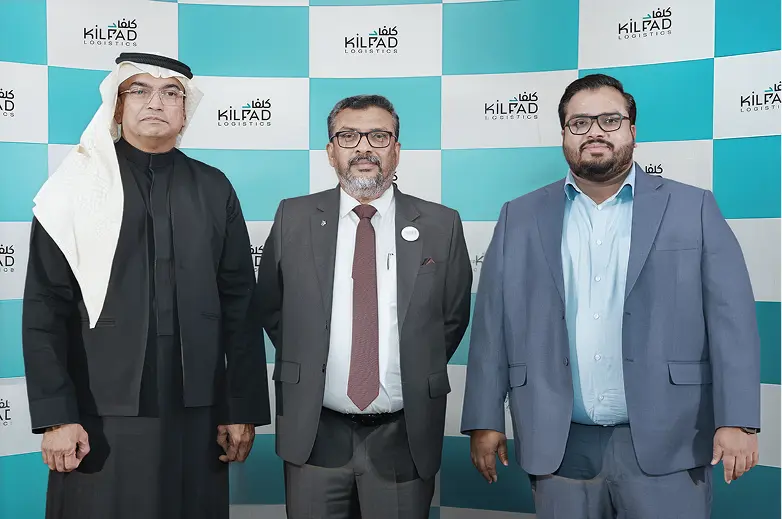
KiLFAD Logistics marks its 30th anniversary with more than 200 employees, over 50 trucks and a new headquarters in Jeddah. Founded in 1996 as EFS Logistics with just two employees, the company has grown into a multi-service logistics provider operating across Jeddah, Riyadh and Dammam. With plans to expand its fleet beyond 500 trucks and establish offices in Bahrain, Oman, Egypt and China, KiLFAD is preparing for a significant new chapter.
The transition from EFS to KiLFAD represents more than a change of identity. It reflects the company’s evolution into a larger, more structured organisation with broader capabilities and international ambitions.
Najeeb Kalappadan, Managing Director of KiLFAD Logistics, has spent three decades developing the business through customer relationships, operational experience and hands-on leadership. As the company expanded, he recognised the need for investment in infrastructure, technology, fleet capacity and management capabilities.
“The EFS model had also depended greatly on personal relationships, individual experience and direct senior-management involvement,” he explains. KiLFAD is now distributing greater responsibility across departments, allowing managers to make decisions closer to daily operations.
Three Decades of Steady Growth
EFS’s growth came through a series of strategic milestones rather than a single breakthrough. A significant step arrived in 2003, when the company secured its Civil Aviation licence and IATA accreditation. During the same period, it began operating in the bonded and free zone at Jeddah Islamic Port, including less-than-container-load (LCL) cargo handling.
These developments strengthened its airfreight capabilities and expanded its experience in cargo consolidation, customs procedures and bonded operations.
Further expansion followed with the opening of its Dammam office in 2010 and Riyadh office in 2011. The company subsequently added warehousing, in-house customs brokerage and container transportation, enabling it to manage more stages of the shipment journey.
“Licences gave us capability, bonded and LCL operations gave us infrastructure, and international agencies gave us reach and scale,” Najeeb says.
Connecting to International Markets
International partnerships helped EFS move beyond its domestic foundations. JAS provided access to overseas offices, international trade lanes and multinational customers. Its relationship with Hellmann Worldwide Logistics introduced larger key accounts and more complex shipment programmes, strengthening its approach to compliance, procedures and operational coordination.
“These relationships contributed much more than shipment volume,” Najeeb says. “They trained our organisation to operate as the Saudi extension of an international logistics network.”
C.H. Robinson now forms part of KiLFAD’s international operations. The company supports customers through customs clearance, transportation, regulatory coordination and destination logistics, managing the Saudi side of international shipments.
KiLFAD has also secured accreditation under ZATCA’s Saudi Authorised Economic Operator Programme in the Trusted Operator category, including Saudi/GCC AEO certification.
Building Accountability and Operational Strength
Nadir Kalappadan, Executive Director, joined EFS in 2012. As the organisation expanded, he recognised that increasing shipment volumes and additional service lines required clearer departmental responsibilities.
Processes that worked in a smaller organisation needed stronger performance measurement, defined ownership and faster escalation.
“Accountability must extend beyond completing an individual task. The responsible team must remain engaged until the agreed customer outcome has been achieved, documented and communicated,” Nadir explains.
KiLFAD is strengthening its internal capabilities across customs brokerage, transport management, project planning, regulatory expertise, quality assurance, training and data analysis. Its own transport fleet provides greater control over scheduling and execution, while specialist teams manage complex supply chain requirements.
International partners remain essential, but KiLFAD aims to maintain ownership of the complete customer experience, regardless of who performs individual operational tasks.
People at the Centre of Growth
With more than 200 employees across three Saudi cities, KiLFAD is developing a stronger management structure. The appointment of a General Manager, reinforcement of the Assistant General Manager role and increased authority for department heads support more effective decision-making.
The EFS Academy, launched in 2023, plays an important role in employee development. Through training in freight forwarding, customs clearance, bonded operations, transportation and customer service, the company aims to strengthen internal expertise and prepare employees for greater responsibilities.
Sameer Kilfaden, Director and Board Member, brings 23 years of experience as Logistics Director at Savola Group. His understanding of transportation, warehousing, stock availability and distribution provides valuable insight into changing customer expectations.
He sees skilled personnel as essential to the company’s future. KiLFAD aims to develop Saudi employees across customs, commercial development, fleet operations, finance, technology, quality and senior management.
Expanding Beyond Saudi Arabia
Through its Vision 2035 strategy, KiLFAD plans to establish offices in Bahrain, Oman, Egypt and China. Each market offers distinct opportunities.
Bahrain provides cross-border road freight connections through the King Fahd Causeway. Oman offers access to important Arabian Sea ports, including Duqm, Sohar and Salalah. Egypt creates opportunities in ocean freight, project cargo and regional trade, while China provides closer access to manufacturers and exporters.
The company intends to establish these offices in phases, guided by customer requirements and cargo movements.
One recent shipment demonstrates its growing regional capabilities. KiLFAD managed 852 kilograms of industrial equipment from Houston through Istanbul to Riyadh before transporting it by road to Kuwait using its own truck. The operation involved airport handling, transit customs, loading and cross-border transportation.
Maintaining Standards for the Future
As the company expands, consistent service delivery will remain a priority. Management plans to monitor fleet utilisation, customs clearance turnaround, delivery performance, billing accuracy, claims and customer issue resolution.
For Nadir, the ultimate measure of success is straightforward: “For me, the clearest evidence of success will be that a customer receives the same KiLFAD standard regardless of whether the shipment enters through Jeddah, Riyadh or Dammam and regardless of which employee or department handles it.”
Thirty years of experience have established KiLFAD’s operational foundations, industry relationships and market presence. Its next chapter focuses on developing its people, expanding its fleet, strengthening its services and connecting Saudi Arabia with more international markets.
For KiLFAD, growth is no longer simply about expanding operations. It is about building a stronger organisation capable of delivering consistent service and taking greater responsibility across the global logistics landscape.