
The Intelligence Behind Tomorrow: Dr. Mohammad Hossein Amirhosseini on AI, Innovation & the Future of Higher Education
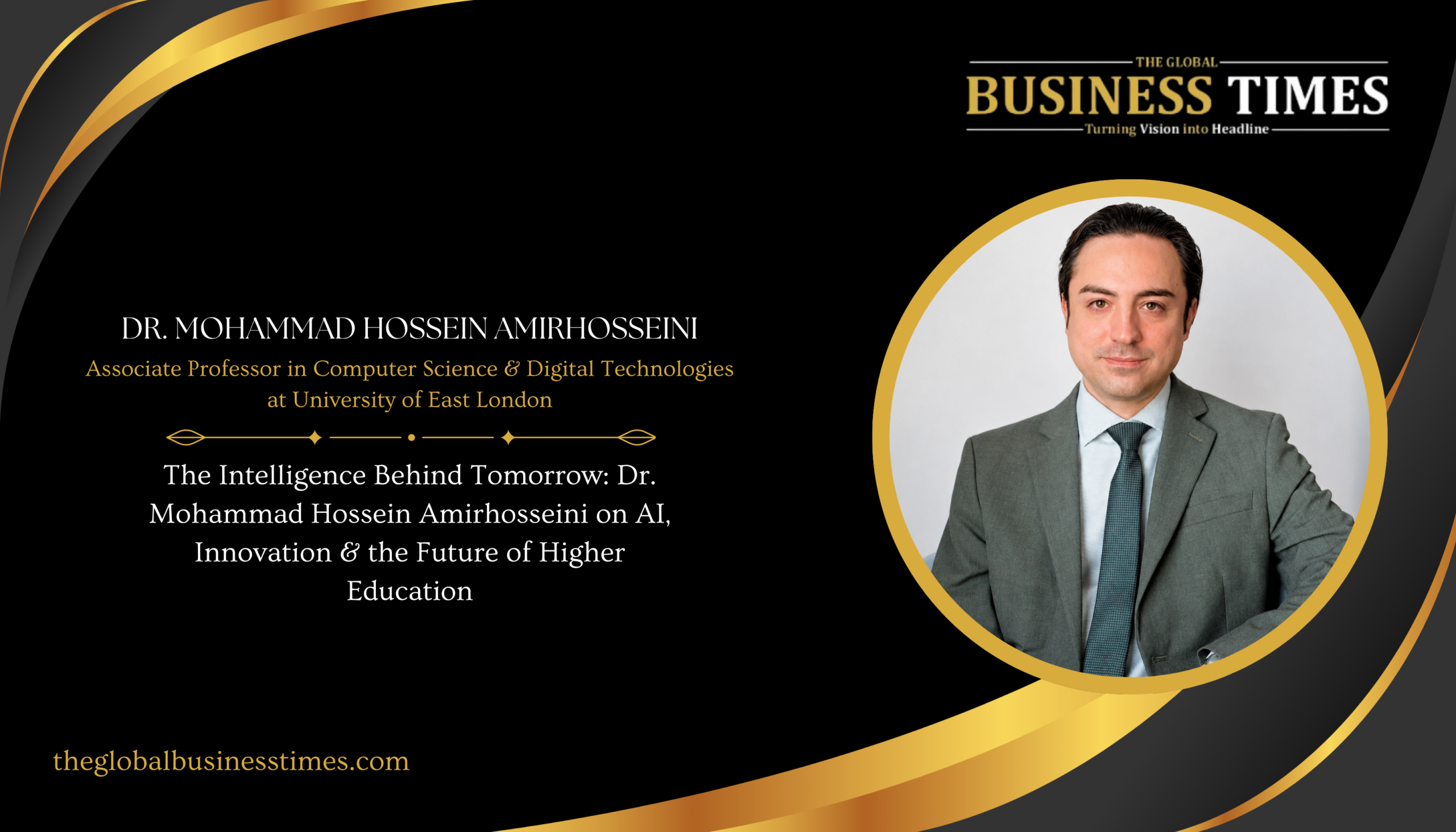
Advancing Artificial Intelligence Through Research, Education, and Human-Centred Innovation
Artificial Intelligence is rapidly becoming one of the most influential forces shaping the modern world. From healthcare and cybersecurity to education, business, manufacturing, psychology, and everyday communication, intelligent technologies are changing how people work, learn, make decisions, and interact with information. Yet the future of Artificial Intelligence will not be defined solely by increasingly powerful algorithms. It will also depend on the researchers, educators, innovators, and leaders who determine how these technologies are developed, applied, and integrated into society.
Among the academics contributing to this evolving landscape is Dr. Mohammad Hossein Amirhosseini, Associate Professor, AI Researcher, and Academic Leader. His professional journey reflects a sustained commitment to advancing Artificial Intelligence while exploring its relationship with human behaviour, cognition, education, cybersecurity, and real-world problem-solving. Through research, teaching, international collaboration, and industry engagement, he has developed a multidisciplinary perspective on how intelligent technologies can move beyond technical capability to create meaningful impact.
His academic foundation began with a BSc in Software Engineering, followed by an MSc in Information Technology and a PhD in Computing in the United Kingdom. His interest in computing was driven not simply by technology itself, but by the possibility of using computational methods to understand and solve complex real-world problems. During his doctoral research, he became particularly interested in the intersection between Artificial Intelligence, human behaviour, and cognitive processes, applying Natural Language Processing and Machine Learning to explore how aspects of human communication and behavioural patterns could be modelled computationally.
This interdisciplinary foundation became an important characteristic of his later work. Rather than approaching AI as an isolated technical discipline, Dr. Amirhosseini has consistently explored how computational intelligence can contribute to challenges across different areas of human and organisational life.
A Journey From Computing to Artificial Intelligence
Following his PhD, Dr. Amirhosseini expanded his research experience through his work as a Postdoctoral Research Fellow on SPIRIT, a €5 million EU Horizon 2020 project involving 17 partners across nine European countries. The project focused on privacy-preserving intelligence and identity-resolution technologies, providing him with experience in international research collaboration and the application of advanced computational methods to complex and sensitive datasets.
His academic career continued at the University of East London, where he joined as a Lecturer in 2020. He progressed to Senior Lecturer in 2023 and was promoted to Associate Professor in 2024. Alongside research, teaching has remained an important part of his professional philosophy. For Dr. Amirhosseini, academic knowledge becomes particularly valuable when it can be translated into learning, practical understanding, and opportunities for the next generation of researchers and technology professionals.
His career illustrates how academic progression can be closely connected to research, education, industry collaboration, and knowledge exchange. Each stage has contributed to a broader understanding of what Artificial Intelligence can achieve and, equally importantly, where its limitations and responsibilities lie.
Where Artificial Intelligence Meets Human Behaviour
Dr. Amirhosseini’s research interests span Artificial Intelligence, Machine Learning, Generative AI, Natural Language Processing, Cognitive and Behavioural Science, and Human-Computer Interaction. This breadth reflects his belief in the importance of interdisciplinary thinking when addressing complex technological and societal challenges.
Artificial Intelligence can analyse enormous quantities of information, identify patterns, automate repetitive processes, personalise services, accelerate scientific discovery, and support decision-making. However, technology does not exist independently of the people who create, use, and experience it. Understanding cognition, communication, behaviour, and human interaction therefore becomes increasingly important as intelligent systems become more deeply integrated into everyday life.
His research has demonstrated the application of AI across diverse domains, including healthcare, psychology, cybersecurity, animal behaviour, manufacturing, energy, and organisational performance. The range of these applications highlights the versatility of AI as an enabling technology. The same fundamental principles of Machine Learning, data analysis, intelligent systems, and computational modelling can be adapted to address very different challenges.
Yet the starting point, in Dr. Amirhosseini’s approach, is the problem rather than the technology. An academically sophisticated AI model has limited value if it does not address a meaningful need. Successful innovation requires an understanding of the environment in which a system operates, the people it affects, and the outcome it is intended to improve.
This perspective has enabled him to connect academic research with practical challenges while maintaining the methodological discipline expected within higher education and scientific research.
Turning Research Into Real-World Innovation
One of the strongest themes throughout Dr. Amirhosseini’s professional journey is the relationship between academic research and real-world application. His collaborations with companies and international partners have involved areas including personal development, cybersecurity, healthcare, behavioural science, energy, and AI-based products.
An example of this approach was an Innovate UK Smart Grant project delivered in collaboration with a UK-based start-up. The project explored the application of AI to automate behavioural and personal development methodologies and resulted in the development of a commercial tool. The work demonstrated how academic knowledge can be translated into practical solutions when researchers and businesses work around genuine challenges.
In another collaboration with a US-based start-up, Machine Learning was used to investigate canine personality and behaviour. This work subsequently led to further research exploring the prediction of training outcomes in working and assistance dogs. Although the application may appear highly specialised, it demonstrates how AI research can be adapted to unusual and highly specific real-world questions.
Healthcare represents another important area of his collaborative work. In collaboration with Moorfields Eye Hospital, Dr. Amirhosseini contributed to the development of a multilingual, voice-enabled retrieval-augmented generation chatbot designed to transform patient education relating to retinal detachment.
Such projects demonstrate the potential of AI to support communication and access to information in areas where clarity, accessibility, and personalisation can be particularly valuable.
For Dr. Amirhosseini, these collaborations also reinforce the importance of bringing together different forms of expertise. Industry can provide domain knowledge, practical constraints, operational environments, and real-world challenges, while universities contribute research capability, methodological rigour, and the ability to investigate ideas beyond immediate commercial pressures.
When these strengths are combined effectively, collaboration can generate research publications, funding opportunities, prototypes, commercial products, student opportunities, and meaningful knowledge exchange.
Reimagining Higher Education in the Age of AI
The transformation brought by Artificial Intelligence extends far beyond industry. Higher education is also entering a period of profound change as Generative AI becomes increasingly accessible to students, educators, researchers, and institutions.
Dr. Amirhosseini believes that universities will increasingly need to move from a model focused primarily on knowledge transmission toward one centred on learning, interpretation, critical thinking, reasoning, and application.
Information is already widely accessible, and Generative AI makes access to explanations and information even easier. As a result, the role of higher education must increasingly involve teaching students how to evaluate information, challenge assumptions, solve unfamiliar problems, and use technology responsibly.
AI can support personalised explanations, formative feedback, simulations, adaptive learning, and academic assistance. When used appropriately, these capabilities could enable educators to spend more time on higher-value activities such as mentoring, discussion, research supervision, and intellectual development.
This transformation also creates an opportunity to reconsider assessment. Rather than attempting to design education as though Generative AI does not exist, universities can create authentic forms of assessment that evaluate reasoning, decision-making, creativity, critical thinking, and the ability to use AI effectively and responsibly.
The purpose is not to replace educators with technology. Instead, AI can become a tool that strengthens the relationship between students and educators, allowing technology to support learning while human expertise remains central to mentoring, interpretation, discussion, and intellectual growth.
Building Artificial Intelligence That Deserves Trust
The enormous potential of AI comes with equally significant responsibilities. As intelligent systems become more capable, questions surrounding bias, privacy, cybersecurity, misinformation, transparency, fairness, and inappropriate automation become increasingly important.
Dr. Amirhosseini advocates an approach in which responsible AI is considered throughout the entire lifecycle of a system rather than being added after development.
Organisations need strong data governance, representative datasets, systematic bias assessment, cybersecurity controls, human oversight, and clear accountability. Developers must also document model limitations and evaluate systems on more than accuracy alone. Fairness, robustness, explainability, security, and unintended consequences all need to be considered.
Governments also have an important role in establishing proportionate regulatory frameworks, particularly for high-risk applications. At the same time, regulation needs to be balanced carefully so that it protects individuals and communities without unnecessarily restricting beneficial technological innovation.
Transparency is another critical element of trust. People should understand when AI is influencing decisions that affect them, and meaningful mechanisms for human review should remain available when significant decisions are involved.
Ultimately, trustworthy AI cannot be created by technologists alone. It requires collaboration between researchers, policymakers, industry leaders, domain specialists, ethicists, educators, and the communities affected by these technologies.
Cybersecurity and Privacy in an Intelligent World
The increasing use of AI also brings cybersecurity and privacy to the forefront of digital transformation. AI can strengthen cybersecurity by analysing large quantities of information, detecting patterns, and identifying potential threats. At the same time, intelligent systems create new attack surfaces and introduce additional risks that organisations must address.
Dr. Amirhosseini’s work on the SPIRIT project demonstrated the importance of combining sophisticated analytics with privacy-preserving approaches. The experience highlighted the need to consider not only what can be achieved with data, but also how that data can be responsibly protected.
In today’s environment, organisations need strong access controls, encryption, data minimisation, continuous monitoring, and rigorous evaluation of third-party AI services. AI models themselves also need protection against threats such as adversarial manipulation, data leakage, and malicious prompting.
However, cybersecurity is not simply a technological challenge. Organisational culture remains equally important. Many security weaknesses can emerge from human or procedural vulnerabilities rather than technology alone. Continuous staff education, clear governance, responsible processes, and effective incident-response planning therefore remain essential.
Digital resilience requires both sophisticated technology and people who understand the responsibilities associated with using it.
Developing the Next Generation of AI Leaders
As Artificial Intelligence continues to evolve, the demand for technically capable professionals will grow. Yet Dr. Amirhosseini believes that technical competence alone will not be enough.
The strongest future researchers and technology professionals will need to combine technical knowledge with curiosity, critical thinking, resilience, communication, adaptability, and interdisciplinary awareness.
AI professionals increasingly need to understand the context in which their systems operate. Ethical, social, organisational, and commercial considerations are becoming part of the responsibilities of technology professionals.
Another essential quality is the ability to work comfortably with uncertainty. Research and innovation rarely follow a completely predictable path. Experiments fail, approaches need to be reconsidered, research papers are rejected, and funding applications may not succeed.
The ability to analyse failure, learn from it, and continue moving forward is therefore fundamental to research and innovation.
For Dr. Amirhosseini, leadership in AI ultimately involves responsibility. Future technology professionals should not only ask whether something can be built, but also whether it should be built, how it should be used, and what consequences may follow.
This mindset can help ensure that technological capability develops alongside ethical awareness.
The Convergence of the Next AI Revolution
Looking ahead, Dr. Amirhosseini expects several technological trends to converge over the next five to ten years.
Generative AI is likely to evolve into increasingly sophisticated multimodal and agentic systems capable of integrating language, images, audio, video, and structured data while performing increasingly complex sequences of tasks.
AI will also become increasingly embedded within everyday software and organisational workflows. Instead of interacting with AI only through standalone applications, people may increasingly experience intelligent capabilities within the tools and systems they already use.
Personalisation is another area likely to develop significantly. In education, healthcare, and professional development, AI systems can increasingly adapt to individuals rather than delivering identical experiences to everyone.
The convergence between AI, robotics, advanced simulation, digital twins, and Internet-of-Things technologies could also create new possibilities across industries.
Yet perhaps the most important question will not be what AI is capable of doing, but what it should be allowed to do autonomously.
As intelligent systems become more capable, governance, alignment, explainability, safety, and meaningful human oversight will become increasingly important. The future of AI will therefore depend not only on improving model performance but also on establishing the principles that guide its use.
A Human-Centred Vision for the Future
At the centre of Dr. Amirhosseini’s work is an understanding that technology should ultimately create human value.
Artificial Intelligence has the ability to analyse complex information, automate processes, support decisions, personalise services, accelerate research, and address challenges that were previously difficult to solve.
But capability alone cannot define meaningful progress.
The most important question is how those capabilities are used.
Through his research, teaching, academic leadership, and industry collaboration, Dr. Amirhosseini continues to contribute to a future in which AI is not only more capable, but also more responsible, practical, transparent, and human-centred.
His career demonstrates the importance of connecting academic research with real-world application, computing with human understanding, and technological innovation with education.
It also reflects a broader shift taking place across the technology sector. The future will increasingly require professionals who can operate between disciplines rather than within isolated areas of expertise.
AI researchers will need to understand people. Educators will need to understand intelligent technologies. Businesses will need to understand responsible innovation. Policymakers will need to understand technological possibilities and limitations.
The ability to connect these perspectives may become one of the defining skills of the next generation.
Shaping Tomorrow Through Research and Education
Dr. Mohammad Hossein Amirhosseini’s journey is ultimately a story of continuous learning, interdisciplinary research, collaboration, and responsible innovation.
From his early academic foundation in Software Engineering and Information Technology to his doctoral research, international postdoctoral work, industry collaborations, and academic leadership, his career has consistently explored how computing can contribute to meaningful real-world challenges.
His work demonstrates that Artificial Intelligence is far more than algorithms and computational power. It is increasingly connected to human behaviour, healthcare, education, cybersecurity, organisational performance, communication, and society itself.
As AI becomes more powerful, the responsibility of those shaping its development will become even greater.
The next era of intelligent technology will require researchers who are willing to explore new possibilities while asking difficult questions about responsibility and impact. It will require educators who can prepare students not simply to use AI, but to think critically about it. It will require organisations that understand innovation must be accompanied by governance, security, and accountability.
And it will require leaders who understand that technological progress should ultimately serve people.
For Dr. Amirhosseini, the future is therefore not simply about building increasingly intelligent systems.
It is about creating systems that can contribute meaningfully to society while remaining grounded in human values.
The defining question of the coming era may no longer be whether Artificial Intelligence can transform the world. It already is.
The greater question is how we choose to shape that transformation.
Through research, education, collaboration, and responsible innovation, Dr. Mohammad Hossein Amirhosseini is contributing to that conversation helping shape a future where Artificial Intelligence is not only intelligent, but purposeful, responsible, and capable of creating lasting human value.