

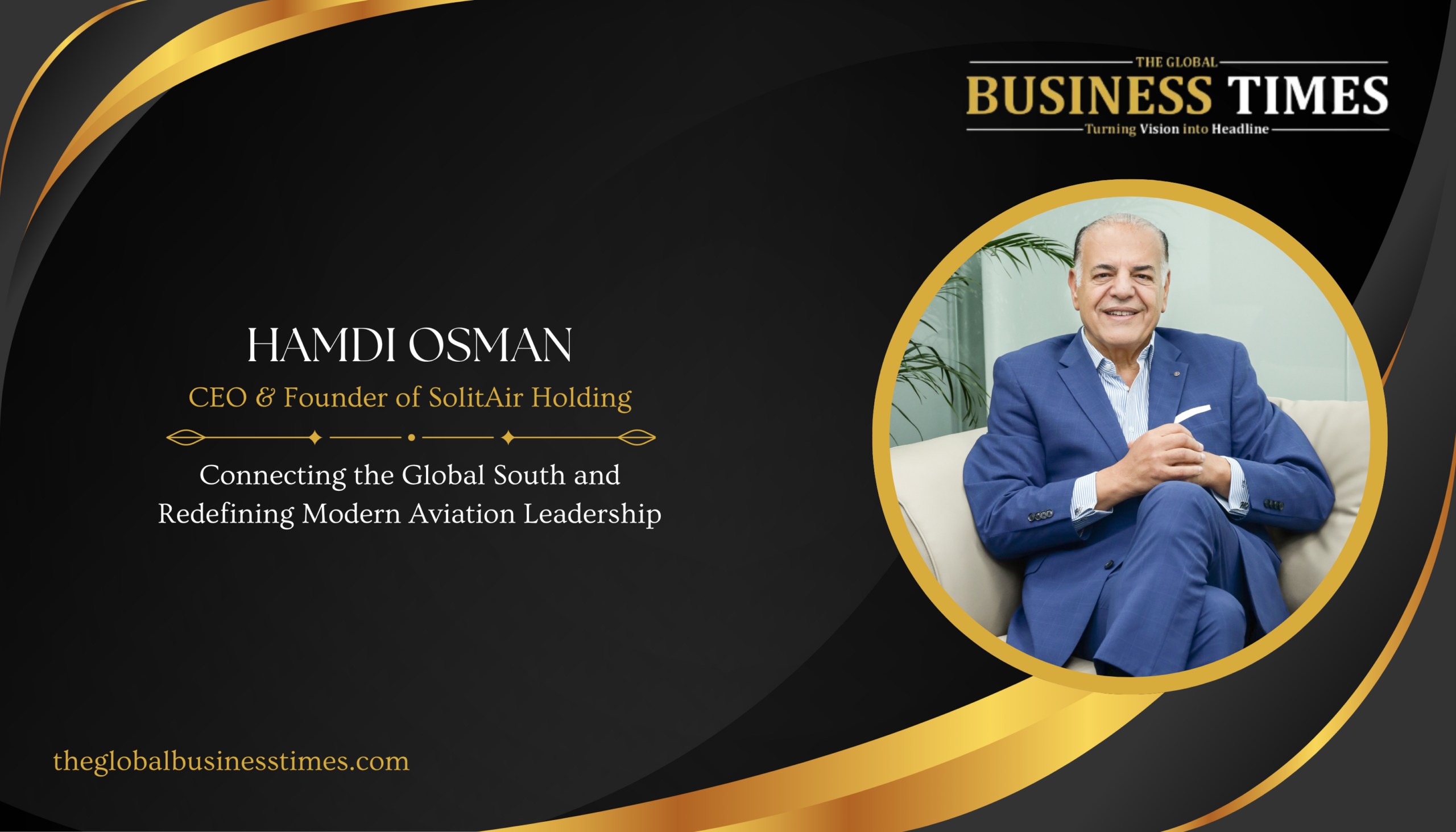
Hamdi Osman: Connecting the Global South and Redefining Modern Aviation Leadership
From the Football Pitch to the Skies: A Journey Built on Humility
Hamdi Osman’s career spans more than three decades of high-stakes operational leadership, global market expansion, and structural innovation across the transportation and aviation sectors. Today, as the visionary force behind SolitAir, his work centers on a persistent challenge in modern global logistics: bridging the critical infrastructure and connectivity gaps that isolate emerging markets. His perspective has been shaped inside demanding decision environments where strategy translates directly into cross-border trade, fleet efficiency, and macroeconomic growth.
Yet, Osman’s journey did not begin in an executive boardroom or an aviation hub. He began his professional life in physical education and as a professional football player. The sports arena instilled in him early lessons of discipline, teamwork, and resilience under pressure. When he transitioned into the corporate world, he entered at the literal bottom of the ladder at FedEx working as a truck washer.
This humble beginning grounded his approach to business, instilling a deep, lifelong respect for every layer of the operational chain. Over the course of 34 years, he grew through the FedEx organization step by step, mastering the intricate mechanics of global supply chains before ascending to senior executive leadership. A defining milestone of his development was graduating from the FedEx Leadership Institute and working directly under the legendary Fred Smith the founder of FedEx and the pioneer of the hub-and-spoke system. This rare blend of ground-level experience, world-class corporate mentorship, and a front-row seat to the evolution of modern logistics inspired a lifelong passion for connecting people, businesses, and global markets.
The FedEx Era: Shifting Frontiers and the Power of People
Spending 34 years with FedEx was a transformative journey that fundamentally shaped Osman’s leadership philosophy. As a senior leader driving the company’s aggressive expansion across Europe, the Middle East, the Indian Subcontinent, and Africa (EMEIA), he spearheaded milestones that went far beyond traditional corporate growth. He was instrumental in building new markets, opening critical trade routes, and demonstrating how robust logistics connectivity can directly revitalize and transform local economies.
However, the most lasting influence on his career was the opportunity to observe and learn from Fred Smith. Smith’s foundational business philosophy PSP (People, Service, Profit) became the cornerstone of Osman’s own management style. Rather than treating it as a corporate slogan, Osman studied how Smith lived this philosophy daily, paying close attention to how he navigated complex business challenges and framed long-term visions.
From this exposure, Osman cemented a core leadership truth: if an organization genuinely takes care of its people, those people will naturally deliver exceptional service, and profit will follow as an organic byproduct. The experience taught him that true leadership is never about wielding authority; it is about embracing responsibility. Every strategic framework he deploys today remains deeply influenced by these decades of high-level execution and foundational trust.
The Genesis of SolitAir: Filling the Middle-Mile Gap
After more than three decades executing at the highest levels of global logistics, Osman recognized a fundamental, unaddressed vulnerability in how the world moves goods. While the industry had successfully optimized first-mile manufacturing pipelines and last-mile delivery networks, the middle mile remained structurally flawed and frequently overlooked particularly across the Global South.
To solve this specific friction point, Osman established SolitAir. The strategic intent behind the airline was not to compete with existing commercial carriers, integrators, or e-commerce giants, but to actively complement them and strengthen the broader logistics ecosystem. By utilizing a nimble fleet of narrow-body aircraft, SolitAir built the operational flexibility required to serve underserved routes and connect cities that had long been excluded from traditional, rigid aviation networks.
At its core, SolitAir is a mission of connection. The airline positions itself as a vital conduit designed to link the Global South with itself, while seamlessly tying these emerging regions back to the established markets of the Global North. By improving this middle-mile connectivity, SolitAir aims to unlock dormant trade lanes, accelerate economic opportunity, and bring fragmented markets closer together.
Structural Shifts: The Five Trends Shaping Global Air Cargo
As the logistics and aviation landscapes evolve under the pressure of shifting global dynamics, Osman identifies five major structural trends that will define the next decade of air cargo:
- Cross-Border E-Commerce Expansion: E-commerce will remain the primary growth engine of the industry, placing unprecedented demands on logistics networks for velocity, flight frequency, and the handling of smaller, high-value shipment sizes.
- Trade Route Diversification: Manufacturing centers are rapidly decentralizing away from traditional hubs and shifting toward South Asia, Southeast Asia, and Africa, creating entirely new cargo corridors that bypass historical East-West trade lanes.
- Geopolitical Realignment: Geopolitics has transitioned into a structural driver of logistics flows. Shifting tariffs, regional conflicts, and sudden airspace restrictions now require networks to adapt and reroute in real time.
- Digitalization and Data Integration: The widespread adoption of advanced data systems is fundamentally transforming end-to-end visibility, operational efficiency, and the overall customer experience.
- Sustainability Imperatives: Escalating environmental and regulatory pressures are forcing a comprehensive re-evaluation of fleet composition, alternative fuel adoption, and daily operational footprint.
Together, these forces are elevating air cargo from a transactional service into a highly strategic, agile, and integrated component of global corporate survival.
Navigating Emerging Corridors: The SolitAir Strategy
SolitAir has strategically anchored its operations at the intersection of the world’s fastest-growing, capacity-constrained trade lanes: Africa, the Middle East, South Asia, and the CIS regions. To identify and capture these emerging opportunities before they become oversaturated, Osman’s team continuously analyzes three core market indicators:
- Macroeconomic data trends and shifting economic growth patterns.
- E-commerce penetration rates paired with acute local logistics gaps.
- Structural connectivity inefficiencies within existing competitor networks.
The Middle East serves as the natural geographical crossroads for this strategy, linking the high-consumption and production hubs of Asia, Africa, and Europe. By establishing efficient point-to-point and hub-and-spoke models through this nexus, SolitAir builds reliable, high-frequency connectivity where it is structurally required by modern trade, rather than where it has historically been convenient to fly.
Scaling with Discipline: The Mechanics of Operational Reliability
In highly competitive markets, rapid growth frequently degrades service quality. To prevent this, Osman champions an operational philosophy where excellence must always lead expansion, never follow it. Maintaining absolute service reliability while scaling a global aviation footprint requires a disciplined, multi-layered approach:
The Operational Scaling Framework
- Standardization: Heavy investment in rigid, standardized operating procedures and uniform performance metrics across every international station to ensure cross-border consistency.
- Visibility: Leveraging real-time tech tracking to monitor cargo flows continuously, allowing teams to proactively resolve operational friction points before they impact the client.
- Simplicity: Prioritizing strict network simplicity and deliberately stripping out unnecessary operational complexities that could compromise delivery timelines.
- Culture: Embedding deep personal accountability, continuous improvement, and customer-centricity into the cultural fabric of the workforce at every level.
- Phased Growth: Deliberately matching fleet acquisition, infrastructure investments, and strategic partnerships directly with verified demand to avoid overextending capacity.
Ultimately, Osman views reliability as the definitive competitive differentiator. In global logistics, customers value predictable consistency over grand corporate promises.
Innovation as an Enabler: The Data-Driven Ecosystem
Digital transformation is rapidly shifting air cargo away from simple, asset-heavy transportation toward a predictive, data-driven ecosystem. Osman views innovation not as a cure-all, but as an amplifier of strategic clarity. The industry is experiencing profound operational improvements driven by three primary technological levers:
[ Predictive Analytics ]
(Demand Forecasting & Capacity Planning)
│
▼
[ Real-Time IoT Tracking ]
(End-to-End Visibility & Asset Control)
│
▼
[ AI & Warehouse Automation ]
(Dynamic Pricing & Automated Operations)
The next frontier of logistics innovation lies in full digital integration creating unified platforms that seamlessly bind airlines, freight forwarders, customs authorities, and end customers together. By erasing transactional friction and enabling dynamic, real-time decision-making, technology shifts the corporate value proposition toward completely frictionless, end-to-end supply chain solutions.
The Strategic Imperative of Environmental Responsibility
Sustainability has transitioned from a matter of corporate social responsibility to a hard strategic imperative for the aviation industry. To build a resilient operational model that can withstand future regulatory and environmental pressures, Osman dictates that airlines and logistics providers must execute simultaneously across three distinct fronts:
Fleet Modernization
Investing in next-generation aircraft to significantly lower fuel burn and optimize emissions intensity per block hour.
Alternative Fuels
Actively adopting and accelerating the integration of Sustainable Aviation Fuel (SAF) into standard fueling operations.
Network Optimization
Utilizing advanced flight planning and operational routing software to eliminate inefficiencies and reduce unnecessary environmental impact.
True industrial progress requires deep collaboration across the entire ecosystem uniting manufacturers, regulatory bodies, and operators around realistic carbon-reduction pathways. In the long term, environmental sustainability will dictate global competitiveness, and the companies that embed these practices directly into their core operating models will be the ones that lead the industry forward.
Purpose-Driven Leadership: Interconnecting Business and Impact
Beyond his corporate and aviation achievements, Osman maintains an active footprint in international investments, global advisory initiatives, philanthropy, and Rotary International. These diverse experiences have deeply influenced his perspective as a global business leader, reinforcing a core belief that commercial success and societal impact are fundamentally interconnected.
Working across varied cultural, humanitarian, and economic sectors has broadened his leadership focus beyond short-term commercial outcomes toward long-term value creation, corporate governance, and social inclusion. Global industries like logistics require a deep appreciation for cross-cultural collaboration. By aligning corporate growth with community impact and a clear sense of purpose, leaders can build resilient organizations that serve as responsible, meaningful contributors to the global society.
Principles of High Performance and Global Partnership
Reflecting on his experience leading diverse teams across vastly different geographic and cultural terrains, Osman relies on three unwavering leadership principles to build high-performing organizations and lasting international alliances:
- Clarity of Vision with Disciplined Execution: Teams perform at their highest potential when corporate direction is definitive, transparent, and paired with measurable benchmarks.
- Empowerment Balanced with Accountability: Direct reports and regional managers must be trusted with the autonomy to act decisively, but they must remain fully responsible for their operational outcomes.
- High Cultural Intelligence: Leaders must actively respect and adapt to local cultural nuances while maintaining uncompromising global operational standards.
Furthermore, Osman emphasizes the critical role of open communication, adhering to the rule of the “3 Cs”— Communications, Communications, Communications. Transparency is the absolute foundation of trust across decentralized global teams. When built on a bedrock of consistency and mutual value creation, partnerships endure market volatility and deliver excellence daily.
A Roadmap for the Next Generation
For entrepreneurs, rising aviation professionals, and future logistics leaders entering a rapidly transforming global economy, Osman offers a focused, threefold roadmap for meaningful impact:
- Maintain Absolute Adaptability: Market demands, geopolitical realities, and technological capabilities will change constantly. Leaders must remain fluid and ready to pivot.
- Balance Strategy with Operational Knowledge: True industry authority requires a deep understanding of both high-level corporate strategy and the ground-level mechanics of daily operations.
- Prioritize Disciplined Execution: Ideas and visions are important, but disciplined, consistent delivery is the only metric that creates a tangible market impact.
Aspiring leaders must build deep personal integrity and resilience to successfully navigate the highly cyclical, demanding nature of global aviation. In an increasingly interconnected world, the future belongs to those who can seamlessly think globally from day one, connecting disparate markets, cultures, and opportunities.
The Vision Ahead: SolitAir’s Global Legacy
Looking toward the horizon, the future of global trade will inevitably be more fragmented, highly digitized, and relentlessly demand-driven. As supply chains prioritize resilience and speed over cost alone, air cargo will occupy a central role in stabilizing global commerce.
SolitAir’s long-term vision is to establish itself as the premier enabler of these critical, emerging trade lanes stretching across the Middle East, Africa, South Asia, the CIS regions, China, and beyond. Backed by cutting-edge technology, standard-setting operational excellence, and an agile network, the airline is built to unlock stagnant trade flows and pioneer new logistics pathways where they are most critically required by the global economy. In doing so, Hamdi Osman is positioning SolitAir not merely as an air cargo carrier, but as a transformative, forward-looking architect of future global trade.